
Darlington County Arrest to Court Records
A Darlington County arrest creates more than one public record trail. The jail entry is a custody record made at W. Glenn Campbell Detention Center when the person is booked, assigned an arrest number, screened, and listed with current status when the roster has caught up. The Sheriff's Office page identifies Sheriff Michael August as the current sheriff, while detention operations and court filing remain separate functions. That jail record may show bail and visitor timeframes, but it is not the final word on what charge is filed in court.
The formal court record is where filed charges, docket events, hearing dates, amended counts, dismissals, nolle prosequi entries, pleas, verdicts, and sentences should be checked. The Darlington County public index is the local Judicial Branch access point, while the broader South Carolina case search hub routes users to public case records. Jail custody details belong with Darlington County jail inmate records, and booking-photo questions belong with Darlington County jail mugshots.
Find Darlington County Court Records
The South Carolina Judicial Branch public index is the main online channel for Darlington County court records after an arrest. It should be searched when the question is about filed charges, court dates, case status, disposition, or sentence. The jail roster is useful at the start because it may identify the person, current custody status, bail amount, and recent arrest or discharge timing. Once the charge is in court, the public index is the better record source.
Search fields can vary by court page, but the research found the Darlington public index commonly supports name and case-number searching. A case number is best when available from a citation, warrant, jail record, clerk notice, or attorney. Name searches are useful for first checks, but common names should be narrowed with first name, date range, court type, or other case details when the portal offers those filters.
| Search Field | Use | Darlington County Note |
|---|---|---|
| Case Number | Exact case lookup | Best when a citation, warrant, clerk notice, or docket number is known. |
| Last Name or Business Name | Defendant surname search | Use the spelling from the jail roster or court paperwork when possible. |
| First Name | Name narrowing | Helps separate people with the same last name. |
| Court or Agency Filter | Case-type narrowing | Useful when records are split among magistrate, municipal, or General Sessions matters. |
| Date or Filing Filter | Range narrowing | Use an arrest, warrant, or filing date when the name search is too broad. |
Darlington Court Records Search Steps
Start with the public index when the goal is a court case, not a custody check. A person can be booked at W. Glenn Campbell Detention Center before all filed charges are visible, so timing matters. The arrest charge listed during booking may be a starting allegation, and the solicitor may later amend, reduce, dismiss, or replace it. If no court record appears right away, check again after first appearance or contact the clerk or solicitor channel for the correct court path.
- Open the Darlington County public index and choose the court or case-search path that fits the matter.
- Search by case number if one is known. If not, search by last name and first name.
- Open the matching case and review parties, charges, events, court dates, and disposition fields.
- Compare the filed charge with any jail roster wording, because the booking charge can differ from the prosecutor-filed charge.
- Use the solicitor, clerk, or FOIA process for records that are not visible online or that need certified copies.
The official Fourth Judicial Circuit Solicitor handles General Sessions prosecutions for Darlington, Chesterfield, Dillon, and Marlboro counties. The solicitor, not the jail, is the office that reviews many serious criminal cases after arrest and decides how charges proceed in General Sessions. If the question is still about current jail custody or bail visibility, the county's Darlington County inmate search page is the correct custody-side source.
Darlington Arrest Charging Documents
A court record after a Darlington County jail arrest can start from several charging documents. A warrant or complaint may begin the accusation, a solicitor may proceed through an information where allowed, and many serious General Sessions charges are presented for indictment. These terms describe how the charge reaches court. They do not prove guilt, and they do not always match the short label that first appears in the jail booking entry.
| Document | Who Uses It | What It Means |
|---|---|---|
| Complaint or Warrant | Law enforcement and a judicial officer | Starts or supports an arrest allegation and may lead to booking and first appearance. |
| Information | Solicitor where authorized | A prosecutor-filed charging document used in certain criminal cases. |
| Indictment | Grand jury and solicitor | A formal General Sessions accusation for more serious offenses after solicitor review. |
The Fourth Circuit Solicitor identifies Paul M. Burch, Jr. as the elected solicitor. In practice, that office reviews law-enforcement cases, manages General Sessions prosecutions, works with victims and witnesses, and decides whether a charge moves forward, changes, or ends.
Darlington County Charge Status
Charge status is one of the most important parts of court records after a jail arrest. A pending charge means the case is still open. An amended or reduced charge means the filed accusation changed after the arrest. A dismissed or nolle prosequi charge means the case or count ended without a conviction on that charge. A guilty or convicted entry means the person was adjudicated guilty by plea, bench trial, or jury verdict.
| Status | Plain Meaning | Why It Matters |
|---|---|---|
| Pending | The charge remains open. | Future court dates or solicitor action may still occur. |
| Amended | The charge text or code changed. | The current court charge may differ from the booking label. |
| Reduced | A lesser charge replaced the original count. | The case may resolve under a different offense level. |
| Dismissed | The court or prosecutor ended the charge. | The arrest record may still exist unless expungement is granted. |
| Nolle Prosequi | The solicitor declined to prosecute. | Eligibility for later record clearing should be checked under South Carolina law. |
| Disposed | The case has a final outcome. | Read the docket entry to see whether the result was conviction, dismissal, or another disposition. |
Bond After Darlington Arrest
Bond connects the jail record and the court record. Darlington County's inmate-search page says the detention center list includes how much bail is for people on the list. That figure should still be confirmed with W. Glenn Campbell Detention Center at 843-398-4220 before anyone travels or pays, because a second hold, federal case, probation matter, out-of-county warrant, or no-bond order can affect release. The court record may also show bond hearings or related orders.
| Bond Type | How It Works | Darlington County Check |
|---|---|---|
| Cash Bond | Money is paid to secure appearance. | The roster may show an amount, but payment method was not posted in static county sources. |
| Surety Bond | A licensed bondsman posts surety. | No county-approved bondsman list was found in official sources. |
| Personal Recognizance | Release is based on a written promise to appear. | Confirm case-by-case through court or jail records. |
| No-Bond or Hold | Payment alone will not trigger release. | May involve serious charges, warrant issues, another agency, federal custody, or ICE. |
Federal pretrial detainees are a special case. The Darlington jail page says the detention center contracts with the U.S. Marshals Service to hold federal defendants awaiting trial. Those release decisions may be controlled by federal court orders rather than ordinary county bond.
Warrants and Arrest Records
Darlington County research found a sheriff Civil/Warrant Division in the official command structure, but no verified public active-warrant search page. If a warrant leads to a booking, the person may appear on the county jail roster once booked into W. Glenn Campbell Detention Center. The court public index may show bench-warrant events, failure-to-appear entries, or court orders when tied to an existing case.
An online absence is not proof that no warrant exists. A person concerned about an active warrant should use counsel, court channels, or the sheriff's procedure rather than relying only on public web searches. The sheriff main line is 843-398-4501, and the after-hours non-emergency line is 843-398-4920.
Charges Versus Convictions
A Darlington County arrest and charge are not the same as a conviction. A charge is an accusation filed or pursued through the court system. A conviction is a final finding of guilt by plea, judge, or jury. Public records can show both, so the reader must look at the disposition and sentence fields before treating a case as a conviction record.
| Record Type | Charge | Conviction |
|---|---|---|
| Stage | Accusation after arrest or solicitor review | Final guilty result by plea, bench trial, or jury |
| Proof Level | Based on probable cause or formal accusation | Requires plea or proof beyond a reasonable doubt |
| Where to Check | Jail roster, warrant, public index, solicitor record | Public index disposition and sentence entries |
| Record Clearing | May be eligible after dismissal or qualifying outcome | Eligibility depends on South Carolina law and case result |
Sealed and Expunged Arrest Records
South Carolina public access rules allow inspection of many public records, but not every arrest or court file remains open in the same way forever. The South Carolina expungement statute is the practical starting point for many dismissed, not-guilty, or otherwise eligible arrest-record questions. Expungement is a legal process, not a request to edit a jail roster by email.
| Term | Effect | Darlington County Route |
|---|---|---|
| Sealed | Hidden from normal public access but not always destroyed. | Check the court order and clerk process for the specific case. |
| Expunged | Eligible records are removed or destroyed as allowed by law. | Use the solicitor or court process tied to the case outcome. |
| Redacted | Some details are withheld while the record remains partly public. | FOIA exemptions may protect active investigations, privacy, safety, or confidential sources. |
Note: A dismissed Darlington County charge may still appear in older systems until the proper court or expungement process is complete.
Darlington Court Records Access Limits
South Carolina FOIA gives the public a right to inspect or copy nonexempt public records, but it also contains law-enforcement and privacy exemptions. That matters when a request seeks arrest reports, booking records, photos, investigative files, or records from a case that is still active. The Darlington County Sheriff FOIA page points records requests to the Public Information Officer mailing channel and lists fees for pages, staff time, and discs.
The official court image below comes from the Darlington County public index access point, the court channel used for public case lookup after arrest.
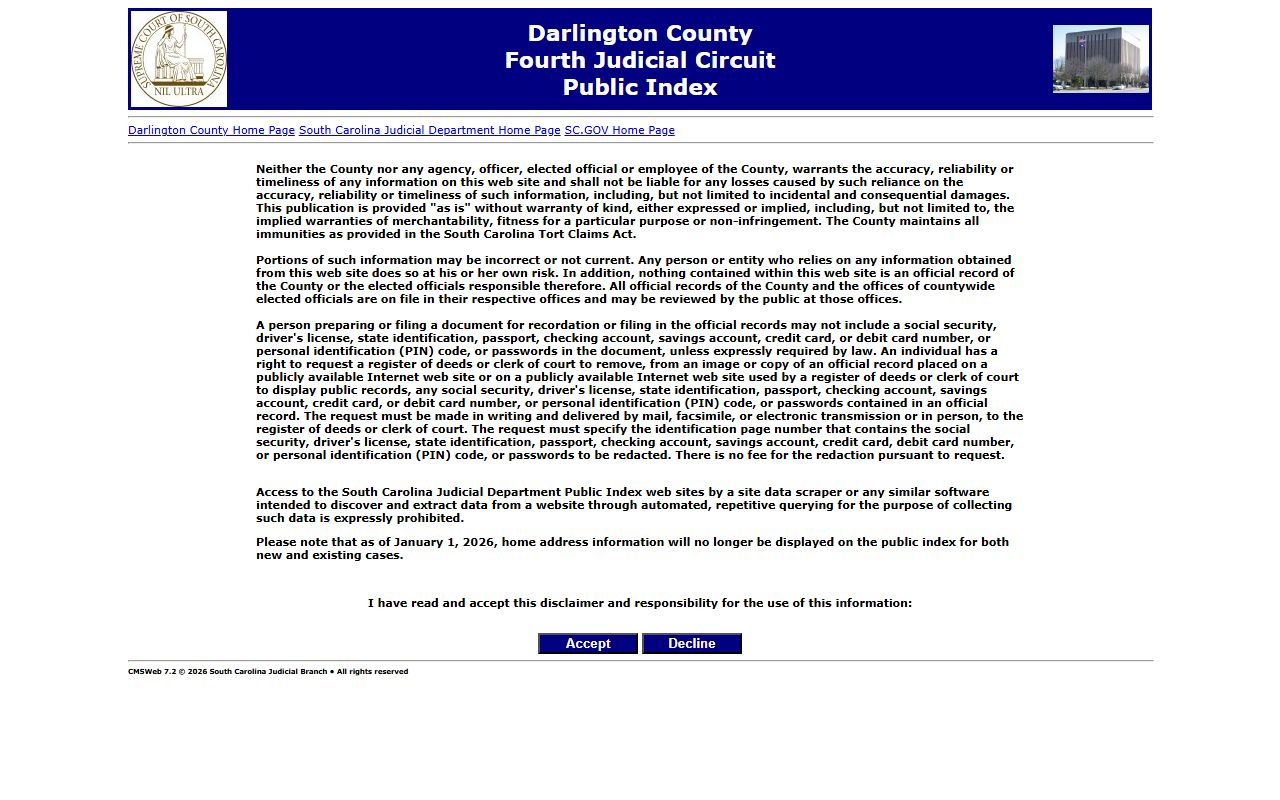
Use the public index for docketed charges and dispositions, then use sheriff FOIA only for jail or law-enforcement records that are not shown in the court system.
Darlington Solicitor Records Contact
The Fourth Judicial Circuit Solicitor is the prosecutor for Darlington County General Sessions cases. The office site says county-specific questions may be routed through the contact page or info@solicitor4.com with the county and request details. Victim-notification needs can also involve VINELink, which is a custody-notification tool and not a replacement for the court docket.
The official solicitor image below is from the Fourth Judicial Circuit Solicitor site, which identifies the prosecuting circuit serving Darlington County.
Use the solicitor for prosecution context and victim or witness service questions, while the public index remains the first online stop for filed court records.
Important: Court, jail, and criminal-history records should be verified with the originating office before any legal or official use.